CRM Automation: The Complete Guide
The four CRM workflows worth automating first, a six-week rollout plan, and the numbers to baseline so you can prove the return.
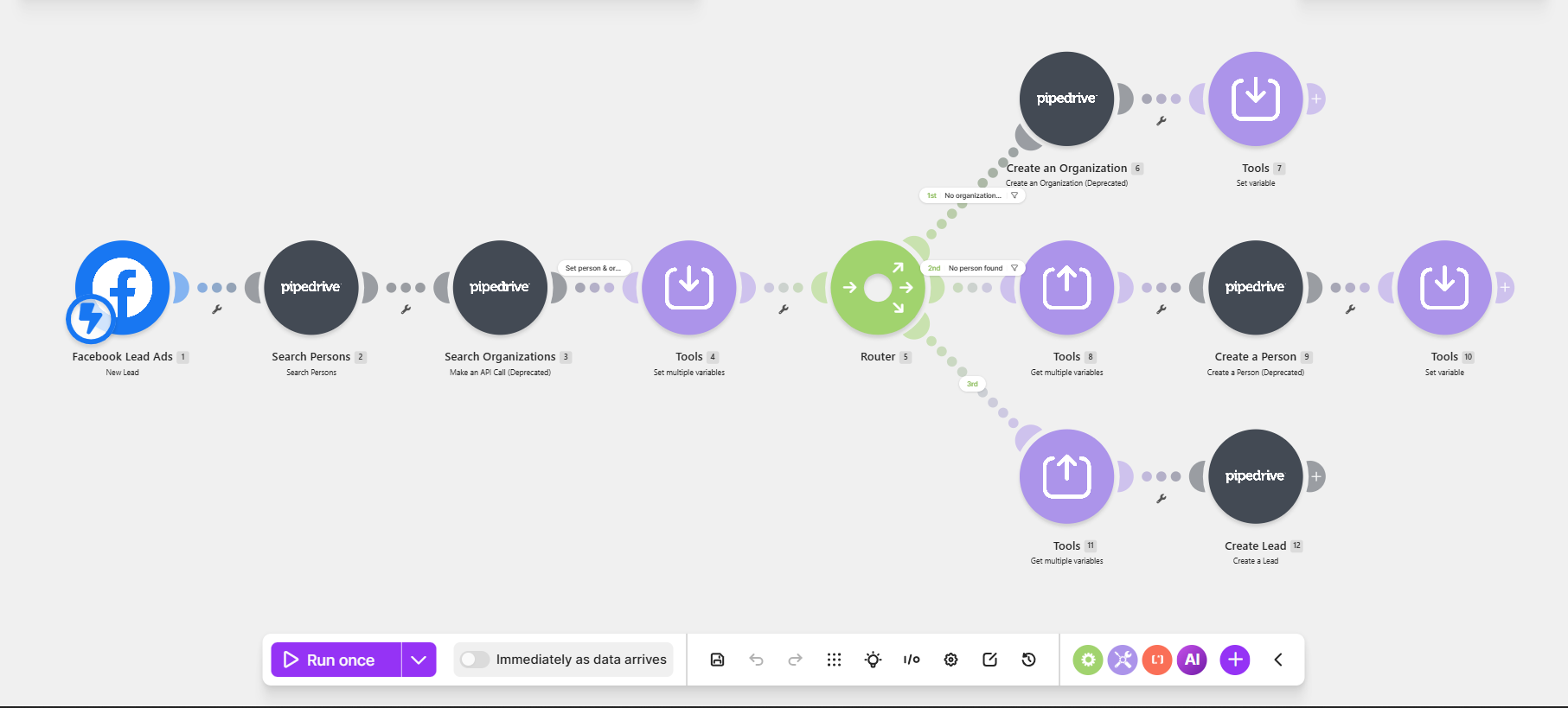
Most CRMs are not underperforming because the software is wrong. They underperform because the data going in depends on a busy human remembering to type it. Leads land in four different places, follow-ups happen when someone has a free afternoon, and the pipeline shows what people hoped would close rather than what is actually moving.
CRM automation fixes the input, not the interface. This guide covers the four workflows worth building first, how a six-week rollout is sequenced, and the numbers to baseline so you can prove the return.
What to build
Four CRM workflows worth automating first
Each one targets a specific leak between an enquiry arriving and revenue landing.
1. Lead capture and routing
The problem: Leads arrive from forms, WhatsApp, referrals, and ads, then sit unclaimed until someone notices them.
What we build: Every source feeds one intake pipeline. Records are deduplicated, enriched, scored, and assigned to an owner within seconds, with an instant acknowledgement sent to the lead.
First-response time drops from hours to minutes.
2. Follow-up sequences
The problem: Follow-ups depend on memory, so warm deals go quiet and never get revived.
What we build: Stage-aware sequences that draft context-specific follow-ups, pause the moment a human replies, and re-surface stalled deals on a schedule you control.
More conversations per rep without more headcount.
3. Activity and note logging
The problem: Calls and meetings are never written up, so the pipeline reflects optimism rather than reality.
What we build: Call and meeting summaries transcribed, condensed to decisions and next steps, and written straight into the deal record with the owner notified.
Clean data that forecasting can actually rely on.
4. Pipeline hygiene and reporting
The problem: Stages are stale, duplicates multiply, and nobody sees the numbers until month-end.
What we build: Nightly checks for duplicates, missing fields, and deals with no next step, plus a weekly plain-language digest of what moved and what needs attention.
Fewer surprises and a pipeline leadership trusts.
Signals
Signs your CRM needs automation
- Leads regularly wait more than an hour for a first reply.
- Your team retypes the same contact details into two or more systems.
- Deals sit in one stage for weeks with no logged activity.
- Reporting requires someone to clean a spreadsheet by hand.
- 1
Week 1: baseline
We measure response time, data completeness, and hours spent on CRM admin so the improvement can be proven later.
- 2
Week 2: capture and routing
All lead sources are unified into one intake flow with deduplication, scoring, ownership rules, and instant acknowledgements.
- 3
Weeks 3 to 5: follow-up and logging
Sequences and automatic activity logging go live, with human review on anything the system is not confident about.
- 4
Week 6 onward: hygiene and expansion
Nightly data checks and reporting digests run automatically, then the same foundation extends into onboarding and retention.
Pitfalls
Five mistakes that break CRM automation
- Automating a messy pipeline instead of simplifying the stages first.
- Sending sequences that ignore what the prospect already said.
- Letting automation write to the CRM with no confidence thresholds or review path.
- Adding fields nobody uses, which makes the data harder to trust, not easier.
- Skipping the baseline, which makes the ROI impossible to defend later.
FAQ
Common questions
Want your CRM to run itself?
Book a free automation audit. We map your pipeline, find where leads and hours leak out, and hand you a ranked build plan.
Keep reading
AI Agents
AI Agents for Business: What They Do and Where to Start
11 min read
AI Readiness
CRM and Knowledge-Base Cleanup Before AI Deployment: A Practical Guide
10 min read
Client Onboarding
Client Onboarding Automation: A Practical Guide
10 min read